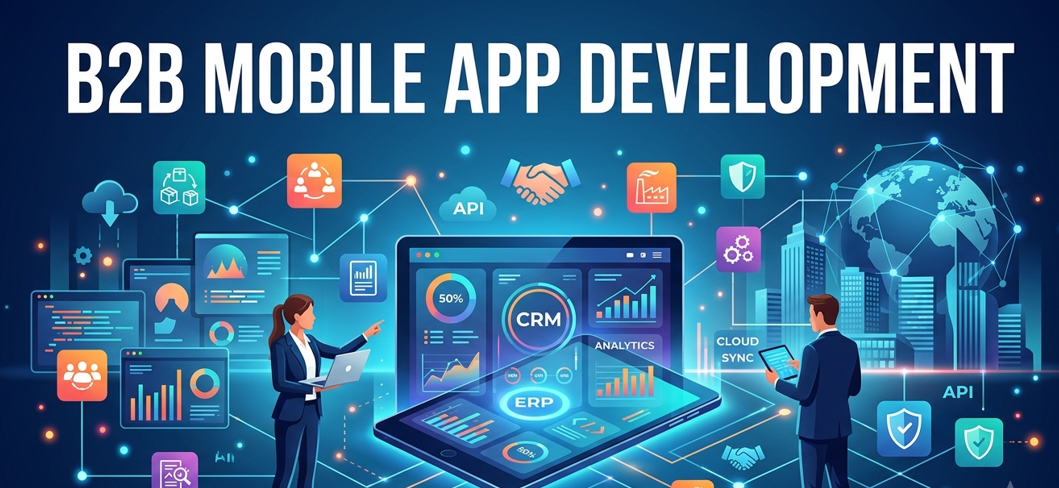
Contemporary firms are always on the hunt for innovative trends and methods to excel during the age of technology. And here comes the need for B2B mobile app development services.
From making processes automated to improving collaboration through improved communication, everything is working perfectly fine to aid firms in their sales and engagement.
In this article, let us discuss all there is about B2B mobile application development.
B2B mobile apps have become a sought-after product among the workplaces in recent times, and what not, it has also witnessed huge growth without any signs of coming to a stop.
B2B Mobile App Development – What Is It?
The development of mobile applications which are designed to provide business transactions, communication, and workflow between organizations, rather than between single clients, is referred to as the B2B mobile app development.
As opposed to B2C mobile applications, which focus mainly on customer experience, the B2B mobile applications are designed in order to optimize business processes, improve scalability, ensure a secure environment and seamless integration with existing enterprise software.
In turn, modern solutions for B2B mobile app development include Android app development services, native iOS app development services, and cross-platform apps depending on specific requirements.
Benefits for Business from B2B Mobile Applications
With your knowledge of the B2B app development process, here we are going to guide you through the basic advantages of B2B app development services. It will make you realize how these apps influence the way business deals are done.
Higher Efficiency
As there is no need for switching applications and writing down information by hand. It leads to faster performance, with less effort and fewer mistakes.
Higher Productivity of Employees
Mobile applications eliminate the friction.
Employees can update work statuses on websites, salespeople can instantly enter the information about meetings and managers do not have to go back to the desktop application in order to approve something.
Small things matter and bring huge results in large corporations.
Engagement
The customers and partners love applications which help them work easier. Ordering, delivery tracking, support all of this can be done easily using mobile devices.
Making Informed Decisions
Managers get an opportunity to react quickly to the issues and notice the trends in real time because of the flow of information to the dashboards.
It is one of the most important benefits in the long term.
For businesses which want to improve their processes and achieve the result, cooperation with the B2B mobile application development company is a guarantee.
Popular Uses for B2B Mobile Applications
Here are some of the top use cases of B2B mobile applications in the real world. Let’s check out.
CRM, Order Entry and Preparation for Sales
The sales force requires quick access to the product catalog, information about customers, prices and the ordering history.
Using mobile CRM allows them to prepare for appointment, manage their pipeline and follow up at the same time.
The inventory management and supply chain, field service, partner portals get the advantages from app development statistics.
Supply Chain and Inventory Management
Logistics, procurement, and warehouse managers use mobile applications to keep track of inventories, alert on shortages, manage deliveries, and scan inventory before it turns into a problem.
Field Service and Workforce Management
Technical staff use mobile apps for receiving job assignments, reporting repair work, accessing equipment history, taking photos, and signing documents without paper forms.
Partner Portals and Distributor Platform
A mobile application helps resellers and distributors to place orders, access marketing materials, manage accounts, and track shipments.
It improves relationships and eliminates manual coordination.
Complete Process to Develop B2B Mobile App
The construction of a productive business-to-business mobile application begins way before any code is developed and released.
The process of development begins by identifying the problem, knowing the user of the app, and charting the workflow that the app will need to have.
Communication and Collaboration Within the Enterprise
This is the stage where all success is born. Collaboration takes place with stakeholders on user roles, workflows, dependencies, and business goals and requirements.
This is the technical audit stage where we look at pain points and process mapping. Failure to take time for this stage always results in scope creep and disappointments.
Requirement Analysis and Gathering
This is where most of the success happens.
Teams collaborate with stakeholders for understanding of their needs and processes, user roles, workflow and system dependencies, business goals, requirements, etc.
The stage involves technical audits, discovering pain points and mapping processes.
Avoiding or underestimating this stage almost always results in scope creep, false expectations and additional expenses afterwards.
User Experience / User Interface Design and Prototyping
In the case of B2B applications, design is not only about making applications visually appealing.
The priority is fast load, clear content structure, and minimal user efforts.
During the stage designers work with information hierarchy, task flows and reduction of clicks number.
Interactive prototypes are created for testing the application scenarios.
Development and System Integration
The stage implies creating frontend and backend, interfaces and APIs.
Application developers will work on implementation of business logic, security and data, performance.
Testing and Quality Control
It includes stress testing, testing for the ability to work offline, for security issues and cross-compatibility with different devices and platforms.
In some sectors, testing for compliance with industry standards may be necessary.
This stage guarantees that the app works in practice, in a real business environment, not just in theoretical situations.
Deployment and Support after the Launch
After the launch of the application, the development team will be responsible for monitoring performance, analyzing usage statistics, bug fixing, releasing updates, and optimizing the app based on usage data.
Updates of the operating system, security patches, and updates of features are all included in the list of the support activities.
B2B apps are always growing with the business.
This is the place where custom B2B mobile app development could be very helpful since there is not any application available on the market which is able to meet complicated business processes.
Costs Involved in Developing B2B Mobile App
The cost involved in making a B2B mobile app usually falls in the range of $20,000 to $125,000 or even more.
The reason is that unlike basic mobile apps that can be used by consumers, B2B mobile applications are very complex in nature, involving enterprise integration, advanced security, and workflow.
Therefore, the cost of development becomes much higher due to these complexities.
There are some other aspects as well that can affect the mobile app development cost in B2B business, which include:
- Location of development team
- Maintenance and updates of the app
- Back end infrastructure and security
- Third party integrations
Important Features of Business Mobile Application Development
If you are planning to develop one of the best b2b mobile applications, below are some of the important features you should not ignore.
Furthermore, working with a b2b enterprise application development company would help you ensure that these features are implemented within the application and work well in complex business-to-business processes.
Invoicing or Cloud Accounting
These features allow organizations to issue, track, and receive invoices directly from their b2b mobile application, eliminating the need for manual processing and delayed invoices.
In addition, invoicing and accounting feature allows the organizations to gain real-time visibility of the payment statuses, receivables, and credit limits.
Appointment Management and Cloud-Based Scheduling
The appointment management and cloud-based scheduling capabilities make it possible for the users of the B2B application development process to conveniently schedule and change the meetings or visits from their smartphones.
Furthermore, due to cloud-based synchronization, the stakeholders get real-time information that is critical when the teams operate in different locations and different time zones.
Promotions and Advertising
Promotions and advertising in the B2B mobile application development process are mainly focused on the use of features such as distributor portals, B2B marketplaces, and partner platforms as opposed to internal enterprise systems.
These are useful in the promotion of priority products, partner deals, discounts per quantity, and new products to relevant business customers.
As opposed to the B2C advertising process, promotions and advertising of B2B applications are mainly driven by data and relationships.
Some of these include customized pricing banners, contract-based offerings, and industry-specific suggestions.
Customer Relationship Management
The inclusion of the technology of customer relationship management as a feature in b2b mobile application development can help in enhancing the positive reputation of an application.
CRM helps in developing quality service relations between the organization and its customers.
The applications designed for mobile CRM in B2B apps can have the most suitable features that include contact management and sales management.
AI-Powered Business Intelligence
The power of AI can help in the best possible manner in the inclusion of the element of advanced analytics in b2b mobile app development through analysis and guidance of the trends in sales, use, and operation data.
In addition, the dashboards and predictive insights help in identifying the most important customers, forecasting demand, optimizing prices, and detecting any anomaly in orders.
Conclusion
It is necessary for you to carefully plan and take into account a number of factors that go into creating a mobile application for B2B.
By now, you would certainly have gained a good insight into the advantages, its various types, essential features, and how to develop a B2B mobile application.
If you are one of those people who are keen on developing a B2B mobile app, then you should definitely consider opting for some well-designed B2B mobile app development services.
It will help your organization to optimize its processes, forge better partner relationships, and open up new opportunities.

Ajay Mishra is a digital marketer and content strategist for software, web & mobile app development company at Serviots. He turns complex tech concepts into engaging, accessible narratives. deep understanding of modern techs stacks and software development, he crafts content that educates, inspires, and drives meaningful conversations. He knows what attracts Google to fetch your content to the top of SERP. When not writing, you’ll find him exploring the latest in digital marketing strategies or reading news on current happenings around the world.
Discover more from Intela Designs
Subscribe to get the latest posts sent to your email.
No responses yet